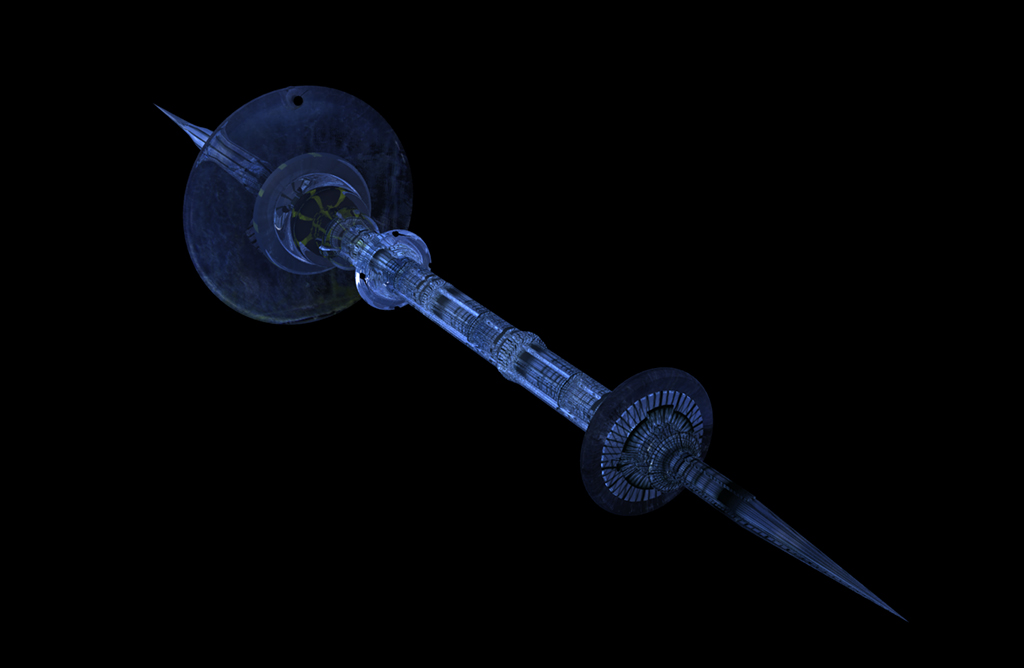
General Dynamics Hull # 2

User avatar
spacekdet
Captain
Posts: 1810
Joined: 27 May 2009, 15:00
Type the number ten into the box: 10
Location: On the day shift at the Utility Muffin Research Kitchen

General Dynamics Hull # 2

Post by spacekdet »

From a scene I poke around in once in a while:

Image

Slightly larger view is here.
User avatar
Draise
Captain
Posts: 3200
Joined: 21 Sep 2009, 19:33
Type the number ten into the box: 0
Location: Bogota, Colombia

Re: General Dynamics Hull # 2

Post by Draise »

Thats one cool looking vessle! Does it run on antimatter or something? what does it do? where is it going? Is it manned? I like the concept!

I have a couple of projects on the low burner, but its refreashing to touch them up again.
User avatar
marcel
Captain
Posts: 2247
Joined: 21 May 2009, 19:52
Type the number ten into the box: 0
Location: paris - France

Re: General Dynamics Hull # 2

Post by marcel »

man has never traveled beyond the solar system. He can not get rid of a vision set in space. I think far from any star, the objects must be illuminated by a diffuse light coming from everywhere and nearly black. Totally different than a hight contrasted image that we can see with the shoot of NASA near the earth. But in this case we see nothing ;)
Design - illustration - Animation
http://www.crea-vision.fr
User avatar
spacekdet
Captain
Posts: 1810
Joined: 27 May 2009, 15:00
Type the number ten into the box: 10
Location: On the day shift at the Utility Muffin Research Kitchen

Re: General Dynamics Hull # 2

Post by spacekdet »

Agreed- lighting right now is bog-standard default and the background is just until I find- or even better- make a better one.
You're correct about how it would be lit in reality.
Still WIP-ing so lights may appear inside & out. ( Does a near light speed ship need headlights? )

Whoops, more modifications ahead, looks like I'm missing the rest of the tail.
User avatar
Finis
Captain
Posts: 5410
Joined: 21 May 2009, 18:26
Type the number ten into the box: 0
Location: America!

Re: General Dynamics Hull # 2

Post by Finis »

Extra cool.

A viewer moving at near light speed would see the "starbow" effect.

Marcel made a good point about lighting far from stars. I wonder though about lighting near a nebula or near a volume densely packed with stars. It could be good to research how bright a nebula might be. It could be that the photos we see are of very faint light and that a human near one wouldn't see it.
I prefer dangerous freedom over peaceful servitude. -- Thomas Jefferson/Jean Jacques Rousseau
User avatar
spacekdet
Captain
Posts: 1810
Joined: 27 May 2009, 15:00
Type the number ten into the box: 10
Location: On the day shift at the Utility Muffin Research Kitchen

Re: General Dynamics Hull # 2

Post by spacekdet »

Over a year later, and it's still chugging through space.
ablative13_01_e.jpg
User avatar
marcel
Captain
Posts: 2247
Joined: 21 May 2009, 19:52
Type the number ten into the box: 0
Location: paris - France

Re: General Dynamics Hull # 2

Post by marcel »

Good light. As under water animal and his own ligth from inside. That how i imagine deep space without sun.
Design - illustration - Animation
http://www.crea-vision.fr
User avatar
Fenerit
Senior Chief Petty Officer
Posts: 173
Joined: 21 Nov 2011, 19:19
Type the number ten into the box: 9

Re: General Dynamics Hull # 2

Post by Fenerit »

Wrong. The Beer-Lambert law states that the coefficient of absorption of electromagnetic waves is proportional to the refractive index of the medium (the empty space, lowest refractive index, near null) and inversely proportional to the wavelength of the light in free space (the space is full of light, in all wavelenghts, also out of galaxy). That vessel could shine so high that should be white even with a couple of sunglasses weared.
User avatar
Finis
Captain
Posts: 5410
Joined: 21 May 2009, 18:26
Type the number ten into the box: 0
Location: America!

Re: General Dynamics Hull # 2

Post by Finis »

Showing the ship with it's internal lights looks good regardless of the issue with realistic lighting. Decide if you want to make the image look realistic with all considerations of brightness, relativistic effects, etc. or to make it look interesting, imaginative, like a sci-fi book cover.

I think, assuming Human-like vision, that if the ship and observer are moving at near light speed (relative to stars) then relativistic effects like the "starbow" would effect the view of the observer. Most light would appear to come from the sides -- from the "starbow" ring. Any light still coming from ahead would be shifted toward short wavelengths while light behind would shift toward longer ones. So the front might be a little more violet and the rear a little more red if any front/back illumination is bright enough for the observer's eyes. If the ship and observer are slow moving vs. stars that's different.

Fenerit makes a good point about space not absorbing much. Absorption in "empty" space must be near zero or our optical instruments (Hubble ...) could not see objects billions of light years away.

The inverse square law or effect is powerful in reducing the energy from a distant source on a reflector to very low levels. It would be the cumulative illumination that counts but the effect of very distant sources would be negligible. The entire galaxy of Andromeda, billions of stars, is invisible or barely visible here. An object would be illuminated by "apparent brightness" ... by sources bright because they are near and some farther away but actually brighter. If the vessel is deep in interstellar space it would probably be dimly lit. Maybe Human visible maybe not. Near some stars then brighter, maybe very bright. In a galaxy the observer could probably see stars. Far inside one of the great voids, empty bubbles, between sheets of galaxies an observer with Human-like eyes probably could see no points of light only a black sky and objects would gain no visible illumination from the very very distant stars.

The best thing would be to get real data about visible light energy from starlight reaching objects with no atmosphere and compare it to the sensitivity of our eyes. Actual Human visual observations would be good too. Maybe the experiences of the Apollo astronauts seeing the far side of the moon in darkness from lunar orbit would be helpful. They also noted how the stars and sky looked from the spacecraft and moon.
I prefer dangerous freedom over peaceful servitude. -- Thomas Jefferson/Jean Jacques Rousseau
User avatar
Fenerit
Senior Chief Petty Officer
Posts: 173
Joined: 21 Nov 2011, 19:19
Type the number ten into the box: 9

Re: General Dynamics Hull # 2

Post by Fenerit »

Finis wrote:Far inside one of the great voids, empty bubbles, between sheets of galaxies an observer with Human-like eyes probably could see no points of light only a black sky and objects would gain no visible illumination from the very very distant stars.
The spacecraft New Horizon is travelling to Pluto. When it will be very close to accomplish fly bys we will see images of Pluto, like I'd seen images of the Uranus' moons. From that distance the Sun is very dim. To say, the Sun at 124 lightyears from the Earth has the same absolute magnitude of the Andromeda galaxy at 2.5 millions of lightyears. Now, if a sci-fi vessel were to be placed at a distance from a galaxy in which the galaxy has the same absolute bolometric magnitude (emitted energy independent from distance) of the Sun at the Pluto's distance, for a distance or a field of view of the human eye like in the vessel's screenshots, we will see the vessel very well; and far more well if at the place of the galaxy there is one of the more energetic quasars. Note that stars with absolute magnitude around -5/-7 like Rigel o Betelgeuse would cast shadows on Earth if placed at 10 parsec of distance (about 32.6 lightyears). Another factor on "visibility" issues is then the albedo.
User avatar
Finis
Captain
Posts: 5410
Joined: 21 May 2009, 18:26
Type the number ten into the box: 0
Location: America!

Re: General Dynamics Hull # 2

Post by Finis »

The distances within a galaxy or even between neighbors are tiny compared to the size of the voids between sheets, "rivers", other structures, of galaxies. While an object in the middle of one of them would receive light from innumerable sources the sources would be very, very, very far away. Light does obey the inverse square law. At these unimaginable distances I doubt a Human eye would see anything. Spacekdet's ship isn't that far from light sources. This extreme example is to make the point that distance matters a lot.

Umm, yes if a light source is close enough or bright enough to a reasonably reflective object it could be lit so we could see it. It could even be blinding. The ship certainly could be in places where it would be well lit.

The question, I think, that is being addressed is how bright would the ship be if far from light sources, far from stars, illuminated by what on Earth we call "starlight". Not cosmic foam void far but within a galaxy out between its stars.

We know from our own experiences (well city dwellers don't) what illumination by starlight is like. It's called "night". At night it is dark. Even with planets and stars and the Milky Way illuminating the night side of Earth it is still dark. Far from city lights on a clear night with the moon not up you can see very little of the ground. This guy http://www.badastronomy.com/bad/misc/badstarlight.html figures that the total brightness of the stars, from Earth, is a little more than that of Venus. Of course only about half of those stars would be shining on the night side at once just as half the sky would shine on the side of a spacecraft facing an observer. The atmosphere probably prevents some of the visible light from reaching the ground so it could be brighter in nearby space.

So, if a spaceship was here but our solar system wasn't (no near by star) it would be lit maybe a little better than the ground away from cities at night with Venus and the Moon not up. The are plenty of stellar neighborhoods where it could be brighter.
I prefer dangerous freedom over peaceful servitude. -- Thomas Jefferson/Jean Jacques Rousseau

Return to “Work in Progress”