
I love working in TS - it's so relaxing (other than it's weird crashes - need to patch it!).
I started sketching some ideas, wondered how to make my world fresh and new, and also wondered how to apply some of Clintons work with the rigging. So far so good. Can't wait to try out his other plugins he created - which I haven't had the chance to.. 'cause my internet access has been very restricted - cut off - the past week.
So here goes my first attempts! I did the tree yesterday and made a nice rig.
Learning SI has been great, because of ICE. I see ICE as a very powerful coding and nodal based system to manipulate a lot of things. I also look at TS and realize.. hang on.. the LE is a lot like ICE. The only problem is it isn't context colour coded data management-ized - and I have no idea what the LE function nodes are or what they do - unlike ICE which is much better documented - concise but ultimately works very similar to the LE. I would love to somehow create a series of ICE like nodes in the LE to modify and work TS like I would in SI for some very cool procedural effects, modification and functions....
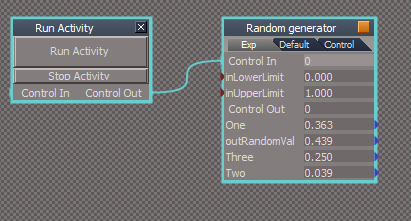
I would love to learn how to do that - for example.. how to expand the matrix values - how to create an average - and use that value to drive another source. I would also like to learn how to make a "randomize" value node - for a position or anything important.
I have a tree with 4 IK controls, and would love to learn how to randomize around a set value to create a number of random trees.
I also have found the the LOD tool on the WS to be AWESOME. I have no idea how I could rig the distance from one object to the value of the Simplification tool - but I could see lots of potential (not for rigged characters though) - how? So that like in games - you can reduce your poly count the further the object is from a set point (the camera for instance). I plan to play with this in this scene to put in HEAPS of trees without bogging down my video card too much.
I also patched TS to have the 64bit architecture, so far it loads more than twice the speed and runs much smoother, brilliant!
So my goals are to somehow figure out how to "randomize" a value around a set limit - use it to drive data - learn to expand and modify the matrix values of an object and morph values to create a "random tree generator".
I also want to learn how to calculate the distance value from one object to another to then use it to drive "simplification" values to run a realtime LOD system for the render-engine in the WS.
But before that.. just casually modelling, texturing and sketching - thinking on how to make the scene - and wondering how to optimize my "pass" workflow - which I could learn how to script that too!!! (Create a script that will take all materials - export them to the root - link them to the pass shader 1, 2, 3 and so forth when required for all shaders present in the scene - not on the object scale - the restore to orginal shader) - Why? So I can do post DOF - motionblur and shadows and potentially Normal shading for lighting effects in post in Blender.
Lots of ideas, not enough know-how.
Clinton! Trueblue! Help!!!!


Ideas for the foilage.

Sketch ideas for the character I want, simple, cute.. effective.

The tree! Modeled and textured roughly.

The rig - simple, effective, with squash and stretch and morph and some basic practices of using no full constraints and scaling the constraint I want using two types. I need to study Clinton's rigging study more to apply it - maybe use his plugins.
I'm lacking ideas for the world, pose, composition, etc.. but I'll get to it. I am thankful for the extra month to work on this.


 .
. 


 familiar with meeting deadlines ...) Who knows, maybe more contestants would enter.


